Every CHRO describes a similar underlying reality, even if they express it differently. Their teams are capable of far more strategic work than they are currently able to deliver, but routine operational tasks consume most of their capacity.
The nature of this work varies across organizations, but the pattern is consistent: recruitment administration, onboarding coordination, leave management, policy queries, compliance tracking, and performance review scheduling. A function designed to develop people and shape organizational culture ends up spending most of its time managing processes that, on closer inspection, do not require human judgment.
This is not a failure of HR teams. It is a failure of HR infrastructure.
What High-Volume HR Work Actually Looks Like
A mid-sized business with around 50 open roles at any given time generates substantial recruitment activity. This includes acknowledging applications, screening CVs against defined criteria, scheduling interviews, coordinating calendars, updating candidates, issuing offers, and communicating rejections. In most organizations, these steps are handled manually, inconsistently, and often later than they should be.
At the same time, the organization is continuously onboarding new employees, each of whom requires system access, equipment provisioning, welcome communications, first-week scheduling, probation tracking, and completion of mandatory compliance training. Much of this coordination is still managed manually across multiple teams and tools.
On top of this sits a constant flow of employee queries: How many annual leave days remain? How do I obtain a salary certificate? What is the remote work policy? How do I submit expenses?
Each request is simple in isolation, but together they create a steady operational load that pulls HR away from higher-value work.
The result is a clear pattern: HR teams are not failing in their responsibilities, they are operating within a workload structure where a large share of demand should never require their direct involvement in the first place.
The Cost of This Model
The cost appears in two main forms.
First, there is the direct cost of time allocation. When an HR team of ten spends around 60 percent of its capacity on routine, high-volume tasks, that is effectively the equivalent of six full-time roles dedicated to work that does not require strategic judgment. At typical employment costs, this represents a significant annual expense for output that adds limited strategic value.
Second, there is a less visible but more consequential cost. When HR capacity is absorbed by administrative work, strategic priorities are deprioritized — not because they are unimportant, but because there is insufficient time to execute them properly. Talent development, culture building, retention strategy, and organizational design suffer as a result.
What AI Workflow Infrastructure Changes
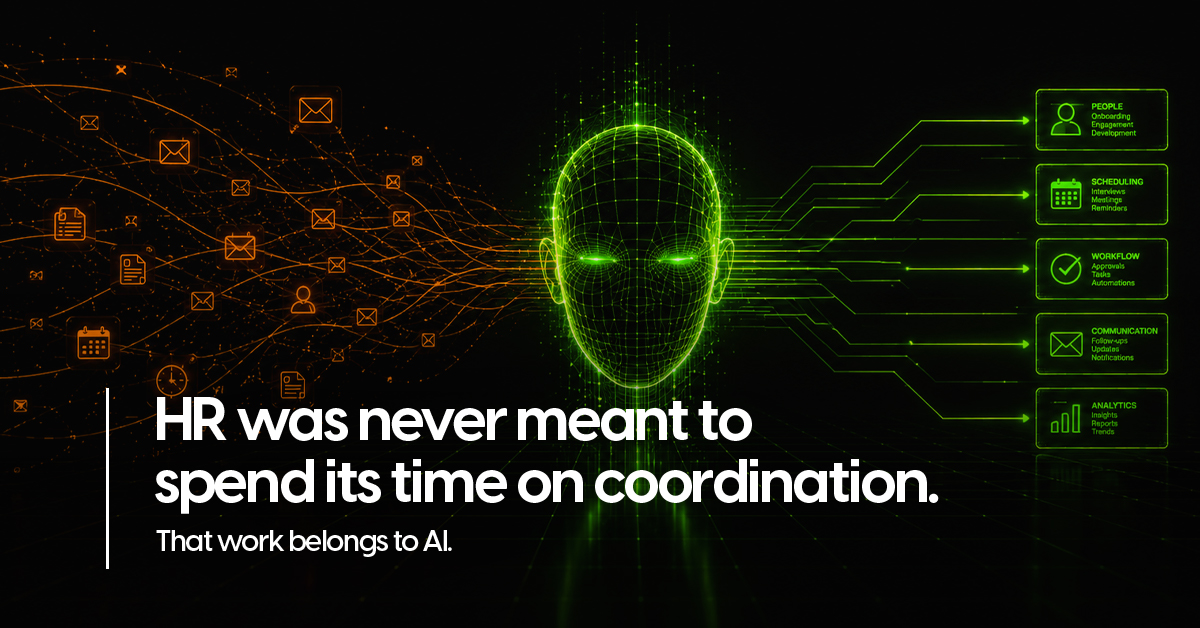
AI workflow infrastructure does not replace HR. It replaces the parts of HR work that do not require human judgment, freeing capacity for the parts that do.
In recruitment, AI systems can manage end-to-end operational workflows for roles with defined criteria. This includes screening applications, communicating with candidates in their preferred language, scheduling interviews, coordinating with hiring managers, collecting feedback, and issuing offer letters. HR retains control over shortlisting and final decisions, while execution is automated.
In onboarding, the same infrastructure manages the process from offer acceptance through to an employee’s first days. It handles documentation, triggers IT provisioning requests, generates schedules, sends welcome communications, and tracks onboarding milestones. HR shifts from coordination to oversight and targeted engagement.
For routine employee queries, AI can respond to questions with clear answers from the HR knowledge base. Responses are immediate, consistent, and available at any time. HR is then able to focus on complex, sensitive, or exceptional cases that require human judgment.
In compliance tracking, systems continuously monitor training requirements, certification expiry dates, and regulatory obligations. They issue reminders, collect confirmations, and escalate risks before they become issues.
The outcome is an HR function that operates closer to its intended purpose, rather than being constrained by manual coordination.
The Implementation Reality
Implementing AI workflow infrastructure in HR does not require a large transformation program. Most organizations begin with one or two high-volume workflows, typically recruitment or employee query management, and expand from there.
The value of AI workflow infrastructure does not come from isolated automation, but from connecting workflows, departments, and operational systems across the organization.
The next step
Ready to build your own communication infrastructure?
Izzi is the agentic AI communication infrastructure platform built for businesses that are ready to lead. See how it works, live, in a real conversation.