
In 1999, a retail business deciding whether to build an e-commerce capability faced a genuinely uncertain decision. The internet was real, the commercial potential was evident, but whether it would become the primary channel for retail was still debated. The businesses that moved decisively, that treated e-commerce not as a channel to experiment with but as infrastructure to build, did not just gain a head start, they established structural advantages that defined the next two decades of retail.
The businesses that waited to see how it played out are mostly footnotes.
We are in a structurally similar moment. The technology is not the internet, but the nature of the decision — whether to build the infrastructure now or wait, and the consequence of getting that decision wrong — are remarkably similar.
What Is Actually Happening Right Now
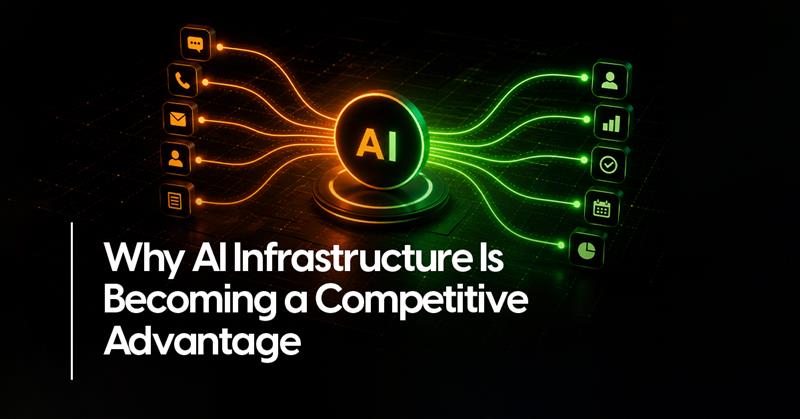
Across every industry that communicates at scale, a small number of businesses are making a quiet but consequential decision. They are replacing fragmented, human-dependent communication operations with intelligent infrastructure — AI layers that connect their customers, their teams, their data, and their operations — and that act in real time without waiting to be told.
These businesses are not making headlines. Genuine infrastructure deployment is not a press release moment. It is an operational decision, made in boardrooms and strategy sessions, that takes weeks to deploy and years to fully appreciate.
But the gap it creates between the businesses that have built it and the businesses that haven’t is already measurable, and it is growing.
Why Infrastructure Advantages Are Different
A product advantage can be copied. A competitor sees what you have built, allocates resources, and produces something comparable. The advantage erodes.
An infrastructure advantage is different. It does not erode — it compounds.
Every month that a business operates on superior communication infrastructure, it generates more data, builds more intelligence into its systems, refines its processes, and moves further ahead. The AI communication layer a business builds today will be significantly more capable in three years, not because it has been replaced, but because it has learned.
The businesses that build it first get three years of learning that their competitors will never recover.
What the Leading Businesses Are Doing
In real estate, AI is conducting property tours with buyers in Tokyo for developments in Dubai, showing the unit, answering questions, completing reservations, without a single sales agent present.
In financial services, AI is managing the full loan origination conversation, handling insurance renewals at scale, and conducting payment collection with a consistency and persistence that human teams cannot sustain.
In retail, AI is guiding customers from discovery through to checkout within a single conversation, showing products, handling questions, processing payments, without the customer ever leaving the interaction.
In aviation, AI is handling flight changes, seat selections, and upgrade requests in real time, across languages, without hold times or queues.
These are not experiments. These are live, commercial deployments generating measurable revenue impact, and the businesses running them are building infrastructure that their competitors will spend years trying to replicate.
The Question Worth Asking Honestly
What does our business look like in five years if our competitors build this and we don’t?
Specifically, how does our lead conversion compare to a competitor that responds in seconds to every enquiry, in any language, at any hour? How does our retention compare to a competitor whose customer communication is perfectly consistent, perfectly followed up, and never drops the ball?
For most businesses, the honest answer to that question is the only argument needed.
The Window
Infrastructure decisions have windows. The window is not defined by a deadline — it is defined by when your competitors act. Once the structural advantages of AI communication infrastructure begin compounding in a competitor’s business, the gap becomes very difficult to close from a standing start.
The businesses building now are not doing so because everything is perfectly aligned — they are building because they have done the honest calculation and decided that the cost of waiting is greater than the cost of acting imperfectly, right now.
With IZZI AI, we are building the nervous system of the world’s businesses. The businesses that plug in now will be the ones that define what their industries look like next.
The window is now open.
The next step
Ready to build your own communication infrastructure?
Izzi is the agentic AI communication infrastructure platform built for businesses that are ready to lead. See how it works, live, in a real conversation.